
Decline, Decay, and Revival
After the Jacksons funded its purchase of the Town Hall and market from Lord Howard, the Council set to work, and in 1920 the traders were evicted from the Market Hall with, according to Sam Ballington, no alternative offer. When it reopened, “many did not return”.
Those that did found the rents doubled, but they could now trade on both Friday and Saturday, with hot water, toilets, a café in the Arcade, and gas lights for every stall – although still no heating. The open market was moved to make space for a new Post Office. For its part, the Council got all its staff under one roof – stylish new offices, the Municipal Buildings, entered through the Classical portico of the old Fish Market.
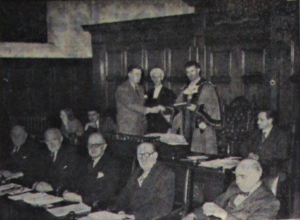
It also got a fully-fitted, top-lit Council Chamber (see photo, 1957) replacing the back room of the Town Hall, in 1849 judged too small for the courts, where for 57 years the councillors had been crowding round an oval table, plus a well-furnished Parlour, replacing a “shabby little den”, in which the Mayor could host visiting dignitaries. The Town Hall was still there for big civic events – Isaac Jackson was made a Freeman in December 1920, Mary Alice Partington in 1925.
When it was finished in 1923, the Council finally had a civic centre fit for a growing, thriving, confident industrial town. Except it no longer was. It was already in a downward spiral which was to last over four decades. The millowners were selling up and leaving, and in 1925, after 319 years, the Howards did likewise. By the 1930s, of the plutocracy which once dominated the town, only Mary Alice remained, still fundraising furiously for a community increasingly dependent on charity; unemployment in Hadfield reached 67%, the second highest in the country. Those who could, left, and between 1921 and 1961 the population declined by 15%.
Inevitably, maintaining its new properties wasn’t a Council priority. In 1933 a section of the lantern roof on the Market Hall collapsed in a storm, and wasn’t repaired for three years, and by the late 1940s parts of the building were described as being in a “ramshackle condition”. It was then struggling for other reasons – rationing meant that traders could sell what little they had in one day, 12 out of 40 indoor stalls being vacant on Saturdays, and the outdoor market “could hardly be said to exist” – but it was also seen as a gloomy, uninviting place, and “many people now leave town on Saturday to shop elsewhere.” Redecoration of the Town Hall was also “much needed.”
In 1950, the Market Hall finally got the new-fangled electric light, and in 1955 the Town Hall, “an unpleasant reminder of how little a local authority can really spend” got a makeover. The forbidding high magistrates’ bench was removed and a new hardwood dance floor installed, and the ceiling painted pink with blue coving, walls blush beige, doors rose pearl. “A mushroom colour also enters into the scheme, and the whole is lined with Kenya red.”
However, the “almost unrecognisable” painting of the 12th Duke of Norfolk, the original builder, was consigned to the ante-room. The Borough Surveyor said that he didn’t think anybody would object “as it was hardly the sort that lent brightness to a room.” He had obtained a quote for cleaning but it was “far more than the Council could afford.”
Much bigger changes were, though, soon being discussed. In the 1930s the Council had realised that the town’s salvation lay in reinventing itself as a commuter suburb of Manchester, “like Altrincham”, complete with electric trains promised for the early 1940s. They were delayed by the war, but finally arrived in 1954, and in 1955 a Town Plan was published which envisaged an increase in population by 1971 from 17,000 to 37,000.
More people meant a need for more shops, and more Council staff and Councillors and hence more office and meeting space. It was also thought that the Victoria Hall, which in 1887 had replaced the Town Hall as the main public venue, would be too small, given the mass social events which were then the norm. And now the Market Hall had electricity, the huge empty space above the stalls, intended by Matthew Ellison Hadfield to provide natural light, was redundant ……
NEXT – Part 18: The Duke Returns
PREVIOUS – Part 16: Owd Fussy, Madam Mayor, and a generous munitions magnate