
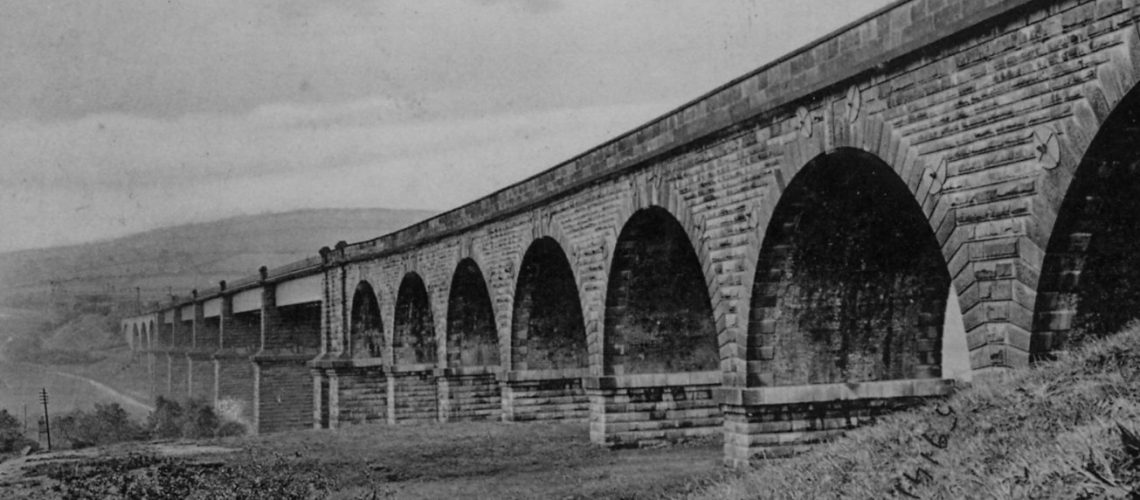
The building of a railway between Manchester and Sheffield had its roots in the early days of rail travel, the first Act of Parliament for a route connecting the two cities being obtained in 1831. Several routes were proposed, the Woodhead one being attractive to the local manufacturers of Glossop because they were at a disadvantage compared to their rivals who were near to a railway and could take advantage of reduced transport costs (both for raw materials and finished goods). As a result of problems raising the necessary capital, it was, however, 1837 before the Act enabling the line to proceed was passed and the ceremony of cutting the first sod took place on 1st October 1838.
It took little more than three years for the line from Manchester to be opened as far as Godley Toll Bar but further progress depended on the construction of the viaducts at Broadbottom and Dinting and the tunnel at Hattersley.
Pigot’s Directory of 1842 tells us that Glossop was situated a short distance from the Manchester and Sheffield railway. The line was expected to be opened to Glossop (which would then be a station) towards the end of 1842 or early in 1843. Alfred Stanistreet Jee, civil engineer and resident engineer to the Manchester & Sheffield Railway Co., is listed as living at Dinting lodge. The directory also lists Richard Preston as landlord of the Railway Tavern (later the Viaduct Inn) at Dinting Vale. Despite the fact that the line was still under construction he had opened the Tavern around two years earlier. In the event the opening of the line to Gamesley was achieved on Christmas Eve 1842. The (then terminal) station at Gamesley was named Glossop.
Dinting Arches
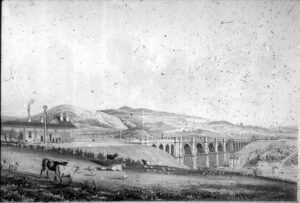
It was to be August 1844 before the Dinting Viaduct was opened and the line could be opened through Dinting to Hadfield and Woodhead. The new station at Dinting was called Glossop, the one at Gamesley being renamed to Old Dinting and becoming a goods station only.

Dinting Viaduct is known as Dinting Arches because it was originally a wooden structure of five wooden central arches with brick arches at each end. Subsequent requirements for strengthening meant that the central arches were replaced by wrought iron girders and the addition of brick piers to supplement the original stone ones.
Glossop Station
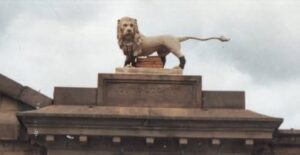
The railway company having decided to bypass Glossop, the Duke of Norfolk undertook the construction of the branch from Dinting. The route was over land owned by the Duke so did not require an Act of Parliament to sanction it. The work starting in November 1842 and the branch was opened to passenger traffic on the 30th June 1845. The Duke subsequently sold the branch line to the Railway Company. Glossop Central station, designed by Hadfield and Weightman, was completed in 1847 and the station at Dinting was renamed once again. Slater’s Royal National Directory of 1850 tells us that Glossop was connected to the main line “by a branch of about a mile in length, terminating at Howard’s Town, where there is a handsome covered station”, also described as “a commodious railway station, with warehouses”. The station is topped by the Howard lion.
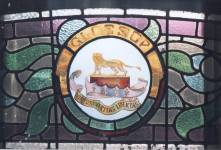
The stained glass window showing the Howard lion, as on the station. The window came from the engine works at Gorton, where there were symbols/coats of arms etc. from the landowners whose territory the line passed through in one of the buildings, presumably part of the admin offices.
The 1850 directory also says that the Manchester, Sheffield and Lincolnshire railway was carried over Dinting Vale by means of a bridge of sixteen arches, the centre five being constructed of wooden planks, ingeniously bolted together, and resting upon massive stone piers. The bridge was described as being “justly reckoned among the ‘railway wonders’ and is indeed, well worth the inspection of the curious in these matters”. Joseph Oates was station master at Howard’s Town, and James Pickford at Hadfield.

The goods department at Glossop was well established by 1855 when the Post Office Directory informs us that George Siddall of Spire Hollin, a member of a long established Glossop family, was manager there. The railway is described as being “carried across Dinting Vale by means of a lofty viaduct of 16 arches, constructed of timber and stone, about 1 mile west from Howard Town, and forms a very pleasing object in its vicinity”.

White’s Directory of 1857 comments that “a branch railway runs to Howard Town, where there is a convenient stone station, with warehouses and coal wharfs, which are supplied from Duckenfield and Dunkirk collieries”. The importance of the railway to the coal trade was documented in subsequent directories by the growth in the number of businesses based at the railway wharf at Howard Town, at Hadfield & Dinting stations and the goods yard at Old Dinting (Gamesley).
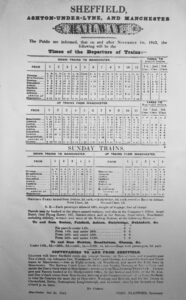
The photo on the left is of a timetable from 1843.
Train Crash at Glossop Station, 1941 On 15th May 1941 a train failed to stop and smashed through the buffers. A similar event occurred in 1949.

A happier occasion was the coming of electric trains in 1954, which meant the end of the need to change at Dinting to get to Glossop.


The platform from which the photo was taken has since been demolished, being no longer of use now that the station is a terminus.