
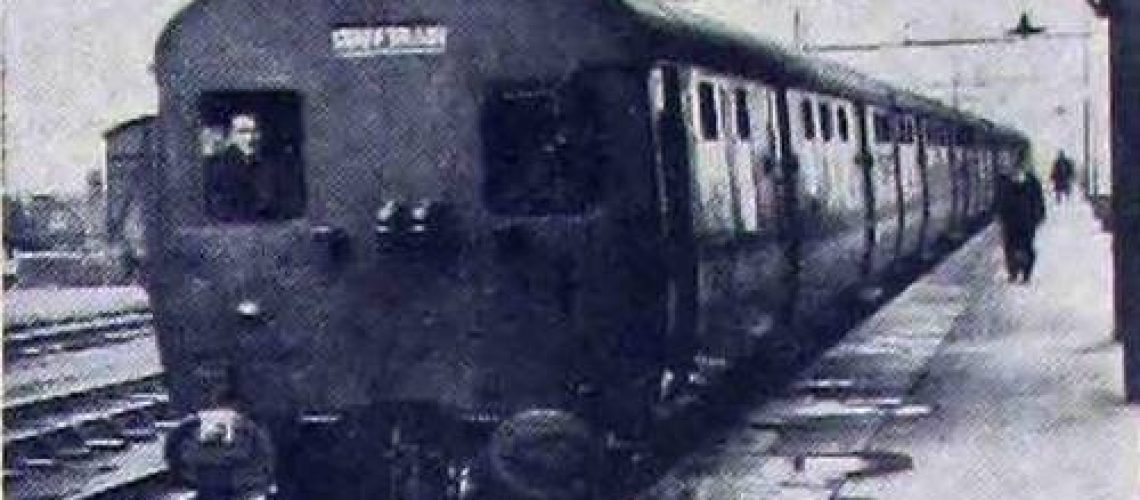
The first use of electric traction on railways in the UK was as long ago as 1883, with the opening of Volk’s pleasure line in Brighton. Whilst schemes for electrification of main lines were discussed during the early years of the 20th century, those actually implemented were restricted to London Underground and suburban lines, using different systems. It was 1921 before a national standard, using 1,500 V d.c. overhead lines, was agreed by government.
It was during the 1920s that the possibilities of electrifying the London and North Eastern Railway between Sheffield and Manchester (about 41 miles) were seriously explored. The catalyst was increased volume of traffic coupled with the restrictions imposed by the 3 mile long Woodhead tunnel. As a result of insufficient ventilation, only one train was allowed in the tunnel at once and, as it took a passenger train six minutes to pass through, a maximum of only 10 trains an hour could travel through it. Electric trains would not travel any faster than steam trains, but they could run closer together on the line, meaning that more trains could use the tunnel in any given time span. The Sheffield Daily Independent reported, on 1 April 1929, that a third rail system (similar to that in use by the Southern Railway) was being considered. As it was aimed at enabling a greater number of through trains on the main lines, there was no proposal to electrify the shunting lines which could still be worked by steam engines. At the time it was still only a consideration and it was reported that no decision had been come to, or was likely in the near future. The change-over was “entirely dependent upon a trade revival in Lancashire and Yorkshire.”
A further problem on the line was the gradients it included (over a large section of the line there was a ruling gradient of one in 80). From Sheffield there was a 19 mile continuous climb, at a very steep gradient, to Woodhead tunnel, where it started to fall steeply through the tunnel and for the rest of the journey to Manchester. The same newspaper reported, on 5 November 1935, that those factors caused an acute problem in working goods traffic, owing to the slow average speed and the long headway necessary between trains. Electric traction would allow regenerative braking to be adopted, instead of continuous braking, and much higher speeds could be achieved as a result. The Manchester-Penistone-Sheffield line was the L.N.E.R. main East-West route, and had a large volume of passenger traffic from London and Scotland in addition to heavy goods traffic. The higher speeds would mean that times between Manchester and Sheffield would be shortened, and it was estimated that from 20 to 25 minutes would be knocked off the 90 minute steam hauled express run between the two cities. The cost of the Sheffield-Manchester electrification was estimated to be in the neighbourhood of £4,000,000.
It actually took a further year before the directors of the L.N.E.R. approved the scheme for the electrification of the lines between Manchester and Sheffield. The total number of route miles to be electrified was 74.56. If sidings were included and the mileage was reduced to terms of single track, the total number of individual track miles to be electrified was 292.71.
Eighty-eight electric locomotives were to take the place of the 181 steam locomotives on the existing service. In addition to 9 express passenger engines and 69 mixed traffic locomotives, there would be 10 banking engines, which would be used to push the coal trains over the extremely arduous gradients between Wath concentration sidings and Dunford Bridge, at the east end of the Woodhead tunnel. 41 specially constructed 40-ton vacuum fitted brake vans would be provided (attached next to the electric locomotive) to provide reserve braking power to enable control of the heavy coal trains in descending from the Woodhead tunnel to Manchester, which is mostly on a gradient of 1 in 117 or more. The total cost, at that time, was reported as being in the neighbourhood of £2,500,000.
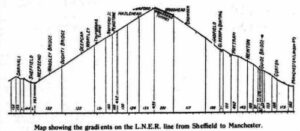
The Sheffield Daily Independent of 14 January 1938 referred to an article in the “Penistone Almanack” quoting the “Railway Gazette” and including this map of the gradients.
The Glossop Chronicle of 14 January 1938 reported that the branch line from Glossop and Dinting to Glossop Central would be included in the initial scheme, something which had been uncertain previously. The report also confirmed that electrification was to be by overhead lines at 1,500 volts d.c., the higher voltage standard system recommended, especially for long distance main line electrification. It was to be the first 1,500 volt d.c. main line electrification in this country. Electrification work had not yet been started but two sidings on each side of the line near Woodhead were being laid as a preliminary step.
By April 1938, rapid progress was being made with the electrification schemes and it was hoped that the work would be completed in about two and a half years. Self-propelling cranes, designed to work on one set of rails without fouling the adjacent track were to be used in erecting supports for the overhead cables. Contracts worth £1,800,000 had been placed with British Insulated Cables, of Prescot, Lancs, for the overhead line equipment and cable, and with Metropolitan Vickers, of Trafford Park, for motive units for 70 electric locomotives. The frames, superstructure, and wheels of the locomotives were being constructed in the L.N.E.R. shops at Doncaster. A total of 400 miles of track were to be equipped with overhead cables, and 8,500 tons of steelwork, 3,000 tons of copper, and many thousands of insulators and other fittings would be required.
Some 10 months later (February 1939), although the work had been in hand for twelve months, there was little outward sign of developments. Most of the activities were taking place in factories and workshops. Aerial photography was used in plotting of the track for the placing of poles and overhead equipment. Together with other modern methods it greatly reduced the time normally required for such surveys. It was expected that the work would be completed and the line be in operation within the next two years.
Work progressed well and by the end of August 1939, overhead girders (to eventually carry the electric transmission wires) had been erected for seven miles at Woodhead, Hadfield and Sheffield. Special overhead equipment was being provided for the three-mile long Woodhead tunnel. Come the end of December, though, and the remainder of the work on the line (once that in progress had been completed) had to be suspended because of the war. About half the civil engineering work had been completed by then.
In September 1939, it had been decided that only the first of the electric locomotives should be proceeded with, so that work of national importance could be taken in hand. The Glossop Chronicle of 7 March 1941 reported that the first of 70 mixed traffic engines (Electric locomotive 6701) had just been completed by the L.N.E.R. at its Doncaster Works. The new engine was designed to handle main line passenger and express goods trains up to speeds of 65 m.p.h., to haul 1,000 ton mineral trains across the Pennines, and to carry out local passenger and goods train duties. It was carried on two bogies, measured 50ft. 4ins. in length over buffers, and picked up electric current of 1,500 volts d.c. from the overhead wire by means of either of two pantographs (collectors) mounted on the roof.
It was not until after the war ended that further progress was made. The Glossop Chronicle of 29 August 1947 reported a statement issued by the L.N.E.R saying that “Fumes will be banished for ever and Woodhead’s special aroma, which it was once said was reminiscent of that of some of the cheaper ports, will be a thing of the past”. Work was to start immediately on the electrification of the Manchester-Sheffield railway line (the cost of which had risen to six million pounds) and was expected to be completed in four years’ time. Glossop and Hadfield would get new multiple unit electric trains and coal trains would disappear entirely at a saving of 100,000 tons of coal each year.
It was no surprise that the Woodhead tunnels posed a major challenge. After nearly a century of use, deterioration became increasingly evident, chiefly in the disappearance of mortar in the joints of the stone lining. Maintenance was difficult owing to the volume of traffic and before long it was found that the week-end possessions of the lines were inadequate to keep pace with the increasing rate of deterioration. In 1946 the drastic step was taken of giving the civil engineering department absolute possession of each tunnel alternately over a period of nine months so that repair work could be pursued continuously day and night. That necessitated single line working through the tunnel and the diversion of a heavy volume of traffic to other routes. As a result it was decided that a new tunnel would be bored. After taking into account geology and the condition of the existing tunnels, as well as the position of the approach tracks and possible operating needs, it was decided to drive the new bore on the south side of its two predecessors. The contract was awarded to Balfour Beatty and Co., who had carried out the recent repair work to the old tunnels and who, therefore, possessed knowledge of local conditions. The main work was to cost about £2,000,000, with permanent way and signalling apparatus adding another £800,000.
In March 1949 it was announced that preliminary work for the new tunnel was expected to take about six months, and tunnelling would take a further three years. It was expected that the coaches for the Manchester-Glossop service would be ready by about the end of the year. As mentioned above, one of the locomotives was completed in 1941. The next was expected to be built in the near future at Dukinfield with others following quickly afterwards.
The new tunnel was to be straight except for a 600 ft. length of 40 chain curve at the West end and included three ventilating shafts, each sunk 500 ft. down from the hill top level, which is 1,500 ft. above the sea. The middle shaft was the first to be sunk, so that tunnel headings could be driven from it in both directions to meet the borings being driven simultaneously from both ends. Having four working faces would reduce the overall time required. The initial boring was of a “pilot” tunnel, of about one-fifth of the sectional area of the final tunnel. The pilot would then be enlarged to the full excavation size which is 31 ft. in breadth and 24 ft in height. The tunnel and ventilating shafts were to be lined with concrete nearly two feet thick.

In addition to the tunnel, further works were required at Woodhead. The whole station had to be demolished and re-built at a new angle farther to the south, and a new road bridge had to be built. Five houses which were in the way had to be demolished, and new ones built for the occupants. In addition, a new camp had to be constructed to house the workers. During the preliminary works, two of the original drills used to construct the original twin-bore tunnels at Woodhead were unearthed and one of them, in spite of being more than 100 years old, was still in usable condition.
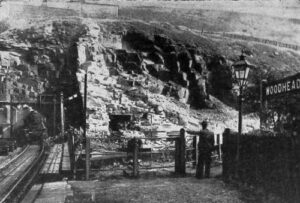
It was 16 May 1951 when a final blast completed the initial pilot tunnel at Woodhead. The charge was fired by the appropriately named Mr. J. C. L. Train, member of the Railway executive responsible for civil engineering. The skill with which the work had been done was demonstrated by the fact that the two parts of the tunnel were only a fraction of an inch out of line.
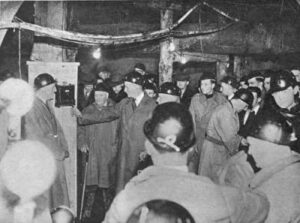
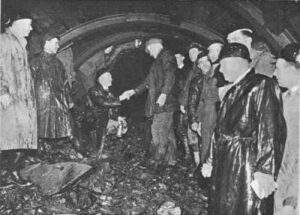 Walter MacCall (left) and Harry Fowler, the foreman of gangs who have worked from the Dunford and Woodhead sides of the tunnel, shaking hands after the pilot tunnel had been opened.
Work on other sections of the line was happening in parallel. The Glossop Chronicle of 9 December 1949 reported on the demolition of the old arched bridge over the railway line at Mouselow, between Shaw Farm and Greenwood’s quarry and brickworks. A temporary bridge consisting of steel joists and timber, capable of carrying heavy road vehicles, was placed in position over the arch, which was blown up at 11:30 p.m. on Sunday 4 December. New bridge abutments were built to take pre-stressed concrete beams which were placed underneath the temporary bridge. The temporary bridge was then be removed and the roadway restored.
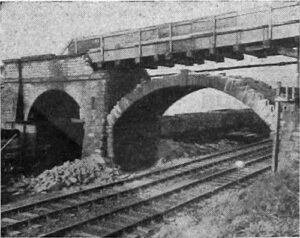
On Sunday 23 April 1950 a start was made on lowering the track at Broadbottom, which was necessary because the stone arch bridge carrying the roadway between Mottram and Broadbottom was not high enough for the overhead transmission wires. The Glossop Chronicle of 28 April reported that the work would take four Sundays to complete, each track taking two.

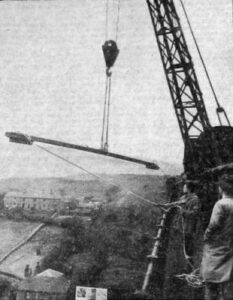
At the same time work was happening on Dinting Arches. A long-jibbed crane was used to swing 29ft. 3ins steel girders underneath the permanent way, where they were fixed on top of the main girders of the viaduct. Overhead structures in the Dinting area had been erected before the war. They were built on concrete foundations but that was not possible on the viaduct.
Some of the work didn’t receive universal approval. The Glossop Chronicle of 21 July 1950 printed a letter under the headline A protest from Hadfield:
Sir, The residents of the Hadfield district around Bankswood are concerned about the proposal to erect a transformer station in front of the Avenue, and in close proximity to Bankswood. We are informed that the British Railways can erect what they wish on their own land, but we call upon our councillors and officials, particularly the Housing and Town Planning Committee to do all in their power to prevent any spoliation of what is one of the prettiest parts of the borough. The time to act is now, not to wait until the project is an accomplished fact and a further monstrosity inflicted on the long suffering Hadfield ratepayers. As I speak for a large body of residents I reluctantly use a nom-de-plume. Yours etc., RESIDENT.
The protest did not succeed. On 1 August 1952 the Chronicle reported that the sub-station had been completed.
A railway official told the Chronicle: “Before finally deciding on the site the greatest care was taken to ensure that this was the only suitable one available. It should be kept in view that when the electrification scheme is finished there will no longer be any smoke from locomotives”.
The sub-station, equipped with two transformers and two rectifiers, was one of 11 being built. 12 track section cabins were also constructed along the route.
Two types of cable were laid along the line. A pilot cable was installed to control the operation of switches from the Control Station at Penistone to intermediate and remote ends of the line, and also provide telephone communications with sub-stations and track sectioning cabins. Extra high tension 33 Kv cable was used to convey alternating electric current from the supply point to the various sub-stations where it was transformed and rectified to 1,500 volts d.c. for overhead line supply.
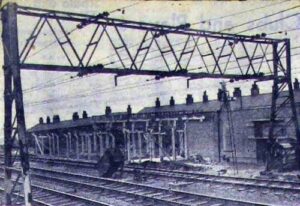
Cable installation on Dinting Viaduct and Mottram Viaduct took place on Sunday 13 August 1951. The extra high tension 33 Kv cable for the 519 yards along Dinting viaduct was in one complete length, specially made to avoid jointing on the viaduct. Weighing 12 tons and contained in a drum loaded on a special cable wagon, the cable was carefully “paid out” alongside the line. A works train, complete with equipment and workmen was used. The operation began at 5 a.m. and lasted until midnight. So as not to interfere with passenger and freight train services one line was kept open. The work linked up a nine-mile stretch of cable from Woodhead to Newton.

Top left: An express rushes through Dinting Station as cable-laying work goes on. Top right: Busy hands as the cable is laid in position. Bottom: A bird’s eye view from a signal gantry.
The Glossop Chronicle of 26 September 1952 reported on the rolling stock progress. The electric locomotives used for Stage 1 were of the Bo-Bo four axle type, the mechanical parts having been built at the Gorton Locomotive Works and the electrical equipment installed by the Metropolitan-Vickers Electrical Company Ltd. at British Railways Dukinfield Factory. Some 30 of these were available to operate between Wath and Dunford Bridge. They had a maximum speed of 65 miles per hour, although the normal working speed, with loose-coupled mineral and freight trains, would be considerably lower. Each locomotive weighed 88 tons.
Work on the permanent way was undertaken using specially equipped trains, each carrying a concrete mixer, water and all necessary materials. Other special trains carried steelwork consisting of masts or uprights, and booms. The steel masts were grouted in or bolted to the foundations and the booms, or horizontal steel girders, placed into position by means of a crane. “Cable trains” were used to lay the extra high tension 33 Kv cable. The special trains were made up of cable wagons loaded with drums of copper wire, store coaches, a coach for meals and an office coach. Coaches were flat topped and a walkway was provided between the coaches to form a working platform. At each site, one end of the cable was secured to an anchoring structure and the train proceeded slowly, during which time the workmen attached the cable to running blocks hung on the steel structures spaced at approximately 210 feet intervals. When the drum length had been paid out and the second anchoring point reached, the cable was again secured.
The Chronicle of 12 December 1952 reported that Glossop council had asked British Railways to bring forward the work of electrifying the line between Glossop and Manchester so that it can be completed and put into operation for the coronation. The request was quickly quashed, it being reported the following week that British Railways had told Glossop Council that the work was not likely to be carried out until after the middle of 1954. Watchman, on 27 February 1953, speculated that the council may have been over optimistic because the power cables appeared to be in position at Glossop.
In addition to the engineering work, by March 1953, the vital task of training of steam locomotive drivers to qualify as motormen was being run at British Railways Duckinfield factory. Men from the Gorton motive power depot were given a course of lectures with the aid of diagrams. The lecturer was a rolling stock inspector and each man was provided with a copy of the lecture notes which, prefaced by an outline of the scheme, explained the mechanism of the electric locomotive. The locomotive drivers were also taught how to prepare and dispose of the locomotives at the commencement and completion of each turn of duty. Practical training was to take place later on when, under the control of leading motormen, the men would be taken out on electric locomotives on a test track.
At the same time, the last of the Bo-Bo class electric locomotives was nearing completion at British Railways Gorton locomotive works, with the electrical equipment being installed by Metropolitan Vickers Electrical Company at the British Railways Dukinfield factory. The first of the Co-Co class, a more powerful type of electric locomotive, weighing 102 tons and capable of a maximum speed of 90 m.p.h. was under construction at Gorton locomotive works, and would soon be ready to receive electrical equipment. Six locomotives of this class were to be built.
Reconstruction was taking place at Dinting station to conform to an improved curve on to the Glossop branch and at the same time the platforms were being raised to conform to Ministry of Transport standards. Pre-cast concrete units were used to rebuild the Glossop arrival and departure platforms. Later on, similar units were to be used to extend the main line platforms at the east end of the station. The platforms at Glossop Central station had already been raised and the awnings cut back to provide clearance for the overhead line equipment.
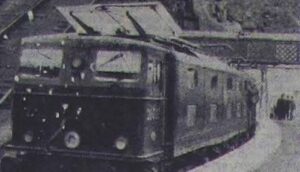
Bo-Bo at Dinting Monday 4 May 1953 was the day that the first electric train, locomotive No. 26003, arrived at Glossop. It was the first of the trial runs, operating on the Glossop branch between Dinting and Glossop and the sidings at Mottram marshalling yard, which were being used not only to test the overhead line equipment and sub-stations, but to train locomotive drivers from Gorton depot (who had already passed the course of theoretical training at the Dukinfield factory).
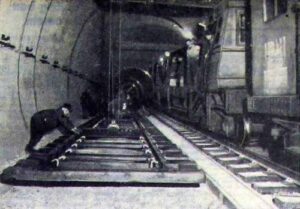
Widening of the new Woodhead tunnel was completed by the beginning of July 1953 and the Glossop Chronicle of 9 October 1953 reported the completion of laying of the double track in the tunnel. The down line had to be laid manually but that track could then be used to run a track laying machine specially developed by British Railways to lay the up line.The mechanical track layer, which had two horizontal jib arms and winches driven by compressed air, completed the laying of just more than three miles of pre-fabricated track for the up line in the brief time of four days.
This was achieved by having 60 feet lengths of track loaded on to trucks, and as each section was lowered into position, by the track layer situated on the adjacent line, so the trucks were propelled forward on the newly laid section by a diesel shunting locomotive.The track layer was also moved forward and continuous progressive track laying was ensured. The track for the up line was pre-fabricated by the civil engineer’s department at Dunford Bridge.The rails used were of the standard flat bottomed type. In total, the job took seven weeks to complete and was finished nine days ahead of schedule.
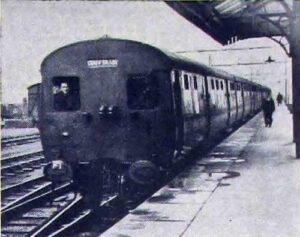
One of the new electric multiple units arrived at Glossop for the first time on 14 December 1953, part of a six-week period of trial runs on the Manchester-Sheffield line. It did not stay long in Glossop station but pulled out again almost immediately. British Railways did not want a crowd of sightseers viewing the train until trials were completed.
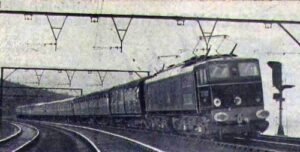
That trial was followed only 2 months later by trials of the new Co-Co locomotives – seven double-bogie, six-axle electric locomotives. The mechanical parts had been built at Gorton Works with the electrical equipment again being supplied by Metropolitan Vickers of Trafford Park. The locomotives, while of the mixed traffic type, were primarily intended for passenger working, had an electric boiler for train heating and were capable of a maximum speed of 90 m.p.h.
By the end of February 1954 all but the last two yards of track laying to join the new track into the existing track at Woodhead had been completed. On 3 June the Minister of Transport and Civil Aviation, the Right Hon. Alan Lennox-Boyd, pressed a button to release a curtain covering the plaque at the portal to Woodhead new tunnel.
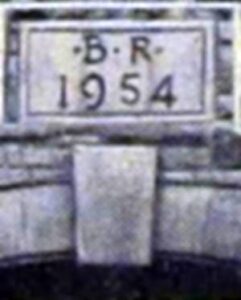
This action lasted only a few seconds, but it marked the completion of the greatest railway civil engineering achievement of 1954 and of one of the most impressive tunnelling works ever undertaken in Britain. The inaugural train through the new Woodhead tunnel was drawn by electric locomotive 26020, known locally as the “Pride of Gorton”.
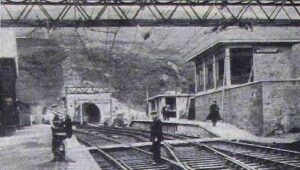
A final trial run of the electric multiple units took place on Wednesday 9 June with Press representatives as passengers, accompanied by officials of British Railways to explain the working of the system to them. The driver, 58-year-old Motorman Rupert Betts, of Gorton, former steam engine driver on the route, remarked on how much cleaner the electric trains were, saying “You could drive that train in your Sunday suit.”.
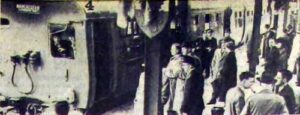
The first “real” EMU train to Glossop and Hadfield left Manchester (London Road) station at 5-15 on the morning of Monday 14 June 1954. The 5-51 a.m. train opened the service from Hadfield to Glossop, where the departure was at 6-02 a.m. for Manchester. It was said that the new all-electric suburban service between Manchester, Glossop and Hadfield was likely to influence the industrial and residential development of the district. Eight “sleek and modern” three-car, multiple-unit trains, each consisting of a motor coach, trailer and driver trailer, with first and third class seating accommodation for 174 passengers, provided the new service, which was considerably augmented. At peak hours two units, making a total of six coaches, operated.
On Saturday June 12, the Glossop and District Railwaymen’s Social Club had held a dinner-dance and whist drive for their fellow-workers, their bosses and representatives of various bodies and sections of the town’s life, in celebration of the occasion.
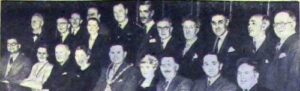
The Mayor, Councillor Bert Turner, himself a railwayman, welcomed the guests in his capacity as the town’s number one citizen. He expressed the hopes of all Glossop that the electric line would be a success, pointing out: “It is important that we make a success of it at the beginning. Do not treat it as an experiment.” Councillor Turner said the town council were “extremely hopeful” that the new service would bring many more people to reside in the town, and so arrest the decline in population over the past past 21 years.
On 25 June 1954 the Glossop Chronicle reported that ticket sales in the first few days were far more than average, as people tried out the new trains, and despite grumbles from some quarters, the service looked like being a continual success. On Saturday, first week-end of the service, Glossop was invaded, and many people were amazed at the number of visitors, something which proved popular with local traders, many reporting an increase in sales for Saturday. A lady from Broadbottom, who shopped regularly at Glossop, was overjoyed “We have never known a service as good as this” she said. “Now I can go to Glossop in a few minutes, and better still I pay less for a better service. Travelling on the bus I had to change at either Charlesworth or Mottram, and it cost me far more.” (There was an approximate difference of 8d. (3.5p) on the return journey).
In amongst all the praise for the new service, some complaints were received. A Hadfield resident complained that the fact that the trains travelled via Glossop added 11 minutes to the time of the journey to and from Manchester for business people. A Charlesworth man pointed out the lack of co-operation between the railway authorities and the North-Western Road Car Co., who operated between Charlesworth and the nearest station – Broadbottom: “Previously, during the morning and evening rush hours (particularly the latter), one did not have to wait very long for a bus from Broadbottom Station to Charlesworth between about 4 and 8 o’clock. Now, the bus leaves about five minutes before the arrival of the train. This means either waiting about 20 minutes for the next bus or undertaking a tedious uphill trek home, which is not a great pleasure during wet or hot weather.”. Despite the small number of critics, the new service was seen as having many praiseworthy characteristics, and it was thought that the majority of people in Glossop and district would be quick to appreciate them.
It took until September before the “crowning achievement” was reached when Manchester and Sheffield were linked throughout by electric traction. On Tuesday 14 September 1954, Sir Brian Robertson, chairman of the British Transport Commission, blew a whistle in Sheffield Victoria Station. Motorman Frank Laming moved the levers in electric locomotive 27000 and the Sheffield-Manchester electric train service was inaugurated. Smoothly and quickly the first passenger train to cover the newly-electrified system set out on its 56-minute run to Manchester. Among the railway, civic and industrial personalities making that first trip was a group of men who worked in the workshops, permanent way, signal boxes and other departments of the railway in Sheffield, Manchester and Wath. They had been chosen by ballot among their colleagues to make the journey and to be guests of British Railways for the day. Full-scale operation of electrically-hauled passenger and goods trains began the following Monday, cutting as much as twenty minutes running time on some passenger trains between Sheffield and Manchester.