
In 1732, the existing road in winter being “in many places impassable to waggons and carriages”, 93 merchants and landowners obtained from Parliament power to turnpike the route from Manchester, via Ashton, Stalybridge and Mottram, to Saltersbrook at the head of Longdendale. The Manchester-Saltersbrook Turnpike Trust was only the second in this region, after Manchester-Buxton in 1725.
The trustees’ minutes give little detail, as they delegated all that to their surveyor and clerk, so it isn’t clear how much was new, and how much just an upgrade of work already done by landowners and parishes (see Part 4). However, they spent only £3500 (about £690,000 today) and finished the whole 25 miles in less than four years, which suggests they did little more than fix the worst problems and bring it all up to a common standard.
That standard wasn’t very high. The carriageway was sometimes less than 11 feet wide, with few passing places, and in Longdendale it still followed the old saltway fairly closely so was often steep, as on the climb to Woodhead Chapel which is about 1 in 9. However, there was a deep stone roadbed topped with gravel, and good drainage, so no more mud – unless, of course, you met a 7-ton stage waggon, with six heavy horses, coming the other way……
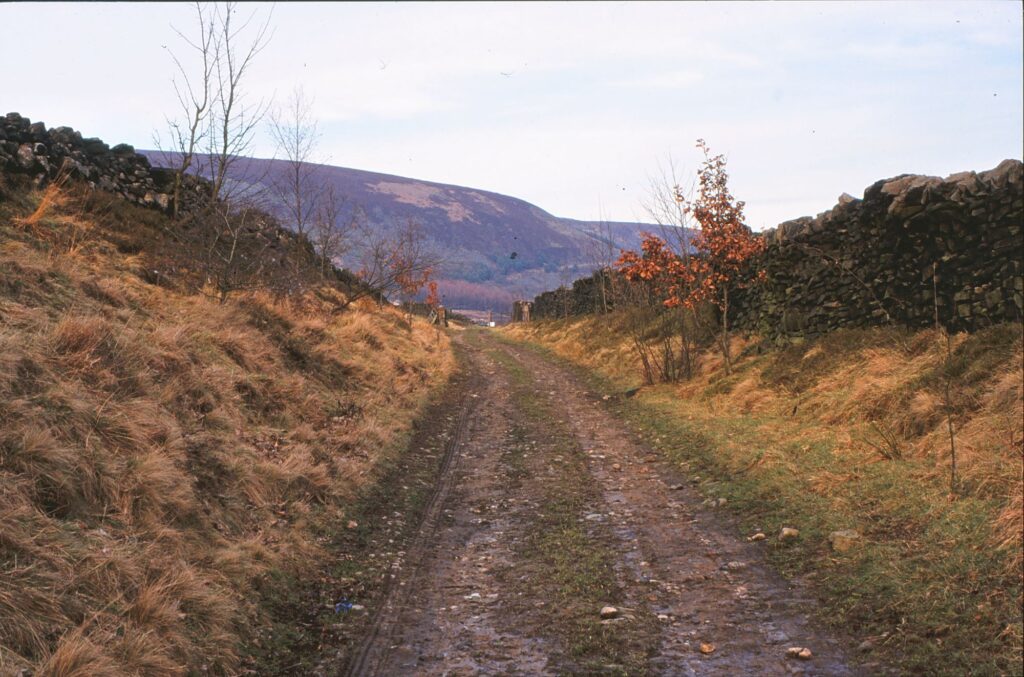
As it was replaced only 90 years later, nearly 10 miles survives as footpaths largely as built. The picture is east of Townhead, and there are also sections north of Rhodeswood and Torside Reservoirs (where it runs along the Melandra-Yorkshire Roman road, see Part 1); east of Woodhead Chapel; and over the high moor between Woodhead and Saltersbrook, the part most feared by travellers in winter.
To get their money back, the trustees set up three toll bars – the “turnspike” was a nasty device fixed along the bar to discourage riders, or at least their horses, from jumping it. Through travellers, especially those on wheels, would pay, the locals mostly wouldn’t, but were supposed to maintain the road. In practice they didn’t, so the trustees had to, and travellers not on wheels found ways round the bars, so it took 60 years to fully repay the loans.
For all its limitations, though, the new(ish) road gave our area cutting-edge travel in the 1730s, and put the domestic textile factors within easy reach of Manchester, the centre of the industry. They could get there in about two hours, do a day’s business and be back in the evening, and in the 1780s that plus the rainfall would make our valleys a very good place for powered mills.
Those mills, however, meant more waggons; and newer turnpikes, constructed on a much bigger scale by professional engineers, could carry the fast stagecoaches beloved of Xmas card artists. What had been cutting-edge in the 1730s was obsolete by the 1780s, and in stages over the next 60 years the Trust rebuilt the entire road. In Parts 11 and 12 we will look at what they did in Longdendale.
Next – Part 6 – Back On The Beaten Track
Previous – Part 4 – Out of the Mud