
Introduction
The Glossop’s Lost Mills series was first published on Facebook in July-November 2020
In 1771, at Cromford, Richard Arkwright built the first powered cotton mill. Glossop, however, was a better place in Derbyshire for mills. There were rushing streams for power; the small villages were on higher ground leaving the valley bottoms free; there was a turnpike road to Manchester, centre of the cotton trade; and the main landowners, the Howards, were keen to encourage the industry and the income it could bring from what was a poor and backward part of their estates. The one thing lacking was a workforce, but there were plenty of skilled textile workers over the hill in Yorkshire, and they came once houses had been built for them. By 1800, most of the mills in the county were in the Glossop area. There were then over 20, but the number rapidly increased until there were eventually over 70.
At first, many spun wool, like Gnat Hole, built in 1790 and the only powered mill from the early period still standing, but cotton was soon king, and from the 1820s on many mills added weaving to spinning, and acquired a steam engine too, although some continued to rely on water, or a combination of water and steam, right to the end. The water was, after all, free, and as often as not there was too much rather than too little.
By the 1850s the four biggest companies – Sidebottom’s at Waterside, Wood’s at Howardtown, Sumner’s at Wren Nest, and Potter’s printworks at Dinting Vale – had become giants employing thousands, Sidebottom’s being the biggest mill complex in the industry. The last of the “big five”, the Rhodes empire at Woolley Bridge and Padfield, grew after the Cotton Famine in the 1860s. Most mills, however, remained small, with perhaps no more than a few dozens of workers. It was hard to compete with the giants, and so many went out of business, or were absorbed into larger firms. Some turned to processing cotton waste from the bigger mills, or to making cotton band or rope, or to bleaching and finishing, and some started making paper, which then became Glossop’s second big industry.

Some stayed small because of where they were. In the early days, the easiest and cheapest source of water power was small, fast-flowing streams in steep narrow valleys, as at Gnat Hole, but there might then not be enough water in a dry season to run a bigger mill, or space on which to build it. In remote locations it was also hard to get or to keep workers, when the railway came the mill was a long way from the station, and if it caught fire (as they often did) it was a long way from the fire station. And in a cloudburst, small streams became big ones and in narrow valleys there was no escape.
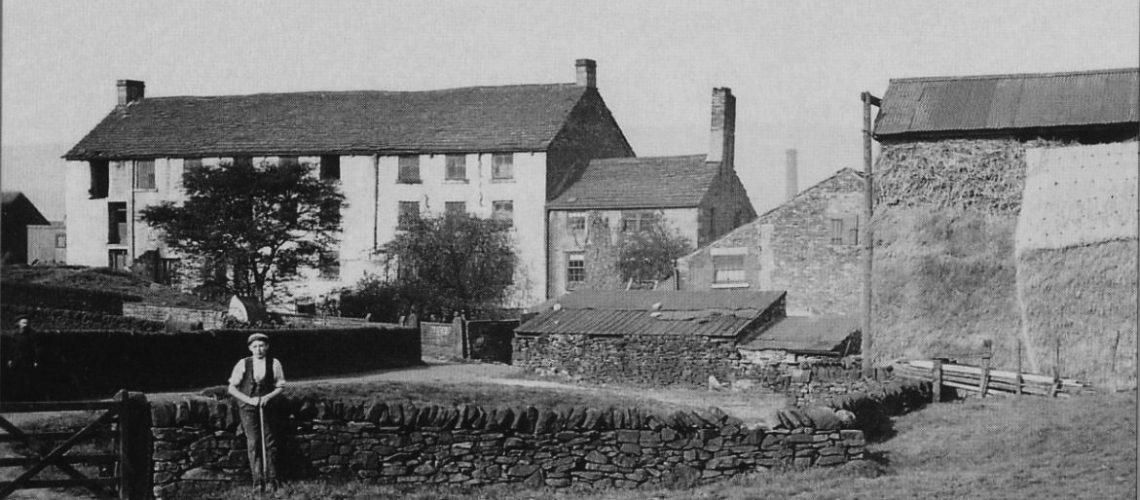
By 1900, most of the small mills had gone altogether or were being used for something other than spinning or weaving. We have photos of only a few, and of some early ones we know very little, as no-one thought to make a record till Robert Hamnett in the 1890s, by which time many were long gone and there were few people around who could remember them. The documents he looked at were also confusing, as mills changed owners and names very frequently, and he sometimes found a reference to an early mill but couldn’t be sure where it was. This series will feature some of those which we do know at least something about, but which have disappeared completely (or almost so) and which are now largely forgotten.
Series Outline
Part 1 – Newton’s Mill, Cross Cliffe
Part 3a – Long Clough
Part 3b – Long Clough – Bridgefield Mill
Part 3c – Long Clough – Lower Turn Lee and Primrose Mills
Part 4a – Padfield Brook – Torside Goit
Part 4b – Padfield Brook – The Thornley Mills
Part 5a – Longdendale – Torside and Crowden
Part 5b – Longdendale – Arnfield Mill
Part 5c – Longdendale – Vale House
Part 7a – Milltown
Part 7b – Milltown Mill
Part 8a – Charlesworth and Chisworth
Part 8b – Charlesworth and Chisworth – Chew Wood
Part 8c – Charlesworth and Chisworth – Mouse Mill
Part 8d – Charlesworth and Chisworth – Charlesworth Mill
Part 9 – Arundel Street and Surrey Mills
Part 10a – Old Glossop
Part 10b – Old Glossop – Waterloo Mills